Digital exclusion refers to the barriers that prevent individuals and communities from accessing and benefiting from digital technologies and services. It is a multidimensional issue that intersects with the building blocks of Health and Wellbeing, and can exacerbate existing inequalities.
The key components of digital exclusion include:
Access: Limited or no access to reliable internet connectivity, digital devices, or infrastructure.
Skills: Lack of digital literacy or confidence to use online tools and services effectively.
Motivation: Low perceived relevance or value of digital engagement, often influenced by personal, cultural, or socioeconomic factors.
Trust and Safety: Concerns about privacy, security, and online harm that discourage participation.
In Devon, addressing digital exclusion is critical to ensuring equitable access to services and opportunities, particularly in rural and coastal areas where connectivity and service availability may be limited. Tackling digital exclusion requires coordinated action across sectors, including infrastructure investment, community-based digital skills support, and inclusive service design.
National Policy Context
Digital inclusion is a national priority, recognised as essential for reducing inequalities and improving access to services. The UK Government’s Digital Inclusion Action Plan sets out commitments to improve digital skills, tackle device and data poverty, and ensure services remain accessible offline. NHS England’s Inclusive Digital Healthcare Framework highlights digital exclusion as a driver of health inequalities and calls for multi-channel access, co-designed digital tools, and targeted support for vulnerable groups. Wider strategies, including the UK Digital Strategy and Levelling Up White Paper, link digital inclusion to economic growth, connectivity, and social equity, emphasising the need for coordinated national and local action.
Digital Exclusion Risk Index
The Digital Exclusion Index (DERI) brings together a broad set of indicators to create an overall DERI score for each lower super output (LSOA). The DERI score is a number between 1 (representing low risk of digital exclusion in that area) and 10 (representing high risk).
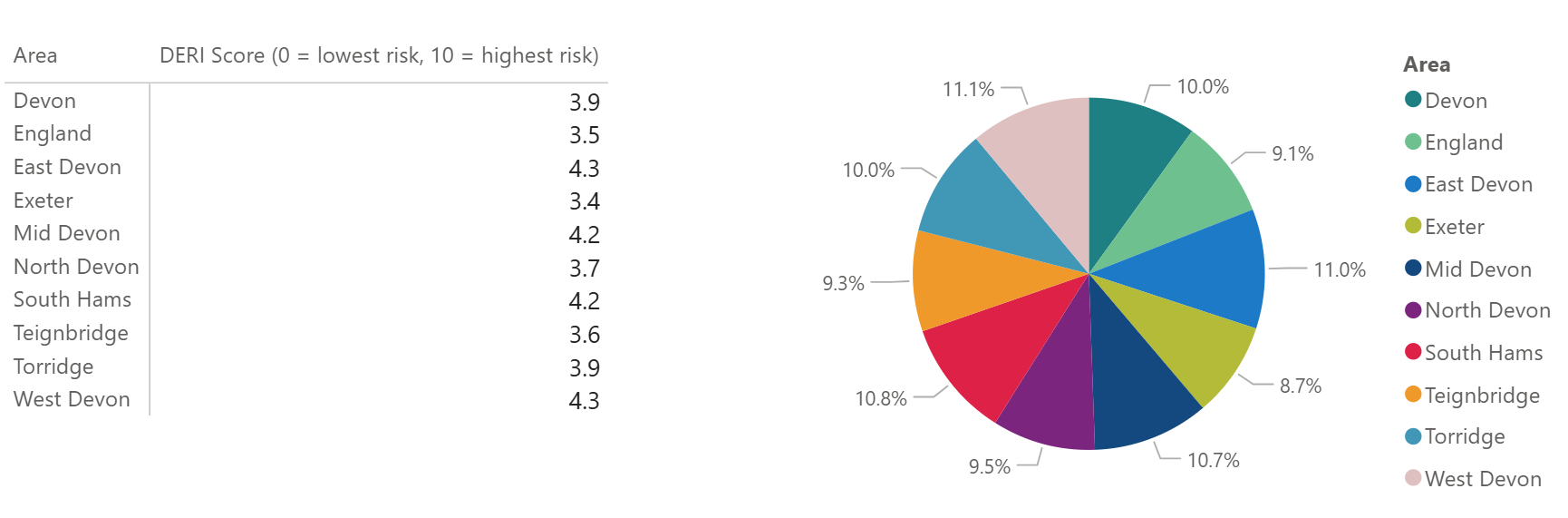
Devon has an overall Digital Exclusion Risk Index (DERI) score of 3.9 out of 10, indicating a moderate level of risk compared to the national context. Within the county, Mid Devon (4.3) and East Devon (4.3) stand out as the most vulnerable areas, reflecting significant rural connectivity challenges. Torridge (3.9) and South Hams (4.2) also show elevated risk, consistent with their rural geography and dispersed populations. In contrast, Exeter (3.4) and Teignbridge (3.6) have the lowest risk, likely due to better digital infrastructure and service availability in more urbanised settings (Figure 1).
Figure 1: Digital Exclusion Risk Index in Devon (Devon JSNA Headline Report – Living and Working Well, 2025)
Digital exclusion risk varies significantly across Devon. While the county average DERI score is 3.9, some small areas experience scores as high as 6.6, indicating severe barriers to digital access and use. In contrast, the least affected areas have scores just under 1, highlighting stark inequalities between communities.
The highest risks cluster in rural West Devon and South Hams, alongside coastal towns in Teignbridge and East Devon, and an urban pocket in Devonport, Plymouth. This reflects a mix of rural connectivity challenges and urban deprivation. Figure 2 provides more detail for areas that are at a greater risk of digital exclusion (see references to access the dashboard for more information).
Figure 2: Digital Exclusion Risk Index by Lower Super Output Area across Devon, Plymouth and Torbay (Devon Digital Exclusion Dashboard, 2025)
Groups most at risk
Digital exclusion does not affect all communities equally. Certain groups face greater barriers to accessing and using digital technologies, often due to a combination of socioeconomic, geographic, and personal factors. Those most at risk include older adults, individuals living in rural or remote areas, low-income households, ethnically diverse populations and migrants, rough sleepers, unemployed people and those with limited digital skills or confidence. These vulnerabilities can compound existing health and social inequalities, making targeted interventions essential. For more information relating to groups most at risk, please visit Digital Exclusion Dashboard Groups at Risk
Insights and lived experience
While quantitative data highlights where digital exclusion risk is highest, lived experience provides essential context on how these barriers affect daily life. Insights from community engagement and local research reveal the human impact behind the numbers, showing how limited digital access, skills, and confidence can deepen inequalities and restrict access to essential services.
Key themes from community insights include:
Limited Digital Skills and Confidence: Many individuals, particularly older adults, lack basic digital literacy. Some have never used smartphones or email and require repeated, one-to-one support to build confidence. This was a consistent finding across Devon and was strongly echoed in the Core 20 Plus Community Connectors Programme evaluation for North Devon and Ilfracombe.
Barriers to Accessing Healthcare and Information: Health and wellbeing services are increasingly promoted online through GP websites and social media. Those without internet access or digital skills often remain unaware of available support. Digital-first systems such as e-consult were described as stressful and inaccessible, especially for people with health conditions or low IT confidence.
Not Inclusive Service Design: Digital platforms for healthcare, including GP systems and apps, were often perceived as complex and not user-friendly. This creates additional barriers for those already struggling with digital confidence.
Affordability and Infrastructure: Rural areas face patchy broadband and mobile coverage, while some households cannot afford devices or data, forcing trade-offs with essentials like food or heating.
Trust and Safety Concerns: Fear of scams and online fraud discourages engagement, particularly among older adults and unpaid carers. Findings from Wellmoor’s research on unpaid carers in East Devon highlighted online safety concerns, low confidence, and mixed experiences with healthcare apps, despite smartphones being the most commonly used device.
Lived experience voices include:
Residents reported feeling “cut off” when unable to access online services or connect with family, contributing to isolation and poorer mental health.
Community-based initiatives such as Forever Connected and Digital Skills Devon were described as “life-changing”, offering patient, in-person support in familiar settings.
Implications for Health and Wellbeing
Digital exclusion amplifies existing inequalities, particularly in rural and coastal communities and among vulnerable groups such as older adults, unpaid carers, and low-income households. Addressing these barriers requires more than infrastructure investment, it demands inclusive service design, affordable access, and sustained, community-led digital skills support.
Digital exclusion has significant implications for service design and delivery. Over-reliance on digital-first models risks widening health inequalities, particularly for older adults, unpaid carers, and rural communities. Commissioners should ensure multi-channel access to health and wellbeing services, embed digital inclusion support within community programmes, and co-design digital tools with users to improve accessibility. Investment in local digital skills initiatives, affordable connectivity solutions, and workforce training to identify and address digital exclusion is essential to ensure equitable access to care.
Recommendations
All stakeholders
Recognise digital inclusion as a core determinant of health and wellbeing.
Embed digital inclusion considerations into all strategies, service design, and equality impact assessments.
For Commissioners
Ensure Multi-Channel Access: Maintain non-digital options (phone, face-to-face) for all commissioned services to avoid excluding those without digital access or confidence.
Fund Community-Led Digital Skills Support: Commission local programmes offering one-to-one or group training in familiar settings, targeting high-risk groups such as older adults, unpaid carers, and rural communities.
Include Digital Inclusion in Contracts: Require providers to identify and support digitally excluded individuals and report on digital inclusion metrics.
For Service Providers
Co-Design Digital Services with Users: Involve people with lived experience of digital exclusion in the design and testing of online systems (e.g., GP portals, e-consult).
Offer Assisted Digital Support: Provide practical help for those struggling with digital tools, including in-person or telephone support.
Train Staff: Equip frontline staff to recognise digital exclusion and signpost to local support.
For System Partners (VCSE, Local Authority Teams, Districts)
Address Affordability and Connectivity: Develop partnerships to provide device loan schemes, subsidised data, and community Wi-Fi hubs in rural and deprived areas.
Promote Digital Confidence and Safety: Deliver training on online safety and fraud prevention, particularly for older adults and unpaid carers.
Share Data and Insights: Use tools like the Digital Exclusion Dashboard to target interventions and monitor progress.