Purpose
Smoking is a leading cause of preventable illness and death in England, with higher rates among Routine and Manual (R&M) workers. This inequality contributes to health disparities and pressures on healthcare services. Understanding smoking behaviours in this group is essential for designing targeted interventions and supporting efforts toward a smoke-free generation.
The purpose of this topic overview is to provide an understanding of smoking behaviours among Routine and Manual (R&M) workers in Devon to inform the development of targeted public health interventions to reduce smoking prevalence and reduce health inequalities.
Prevalence
In Devon, around 23.5% of R&M workers smoke, exceeding the national average of 19.2%. The odds of smoking in this group are nearly three times higher than in other occupations. Although overall smoking rates in Devon are now below the national average (11.6% in 2023), R&M workers remain a key priority due to persistently high rates and associated health inequalities.
R&M smoking prevalence estimated at Lower Super Output Area (LSOA) level, show that the highest rates across Devon are concentrated in coastal towns, market towns, and some rural communities. Ilfracombe and Barnstaple in North Devon report prevalence above 22%. Tavistock and Okehampton in West Devon, Totnes in South Hams, and Cullompton in Mid Devon also have multiple LSOAs exceeding 22%, while Exmouth in East Devon and Newton Abbot in Teignbridge feature prominently with similar levels. Overall, smoking prevalence is notably higher in parts of North and West Devon and rural or semi-rural areas compared to urban centres, with the highest rates clustering around 22–22.35%, significantly above the county average.
Demographics1
Smoking rates differ across demographic groups. In Devon, men are significantly more likely to smoke than women, with rates of 15.1% and 8.6% respectively. Prevalence is highest among working age adults, especially those aged 25 to 29.
Smoking is less common among Black, Asian, and Chinese adults compared to White, Mixed, and Other ethnicities.
Married individuals have the lowest smoking rates, while those with no formal qualifications and unemployed adults show much higher prevalence, at 28% and 29% respectively. This highlights the strong link between smoking and socioeconomic disadvantage.
1 OHID, Fingertips, Inequalities: Smoking Prevalence in adults (aged 18 and over) – current smokers (APS) Smoking Profile – Data | Fingertips | Department of Health and Social Care
Factors influencing Smoking in R&M
The most common factors that influence higher smoking prevalence in Routine and Manual works include:
- Socio Economic Disadvantage: Individuals in routine and manual occupations are more likely to live in deprived areas, where smoking is more prevalent and contributes to wider health inequalities.
- Occupational Stress and Work Conditions: Physically demanding jobs, low job control, and insecure employment can lead to increased stress, which may drive smoking as a coping mechanism.
- Education and Health Literacy: Lower levels of education are associated with higher smoking rates, partly due to reduced access to health information and fewer opportunities to engage with cessation support.
- Mental Health: Routine and manual workers may experience higher levels of stress, anxiety, or depression, which are linked to increased smoking prevalence and reduced quit success.
- Addiction and Barriers to Quitting: Smokers in disadvantaged groups often have higher nicotine dependence and face more obstacles to quitting, such as financial pressures and limited support.
- Cultural and Social Norms: Smoking may be more socially accepted or embedded in the culture of certain workplaces or communities, reinforcing its persistence among routine and manual workers.
- Access to Services: Awareness of and access to smoking cessation services may be lower among this group, despite similar levels of motivation to quit compared to other occupational categories.
Access to Treatment
Quit success rates through NHS Stop Smoking Services vary across regions and time. Nationally, around 52% of individuals who set a quit date successfully stop smoking after four weeks.
In Devon, the most recent data shows a significantly higher success rate of 61.5%, reflecting an improving trend. Devon’s locally commissioned service also shows strong performance among Routine and Manual workers, with quit rates rising from 53.4% in 2021 to a peak of 67.7% in 2024, before a slight dip to 58.9% (Figure 1). These figures suggest effective local support and targeted interventions.
Figure 1: Successful Quit Rates for Routine and Manual Smokers across Devon
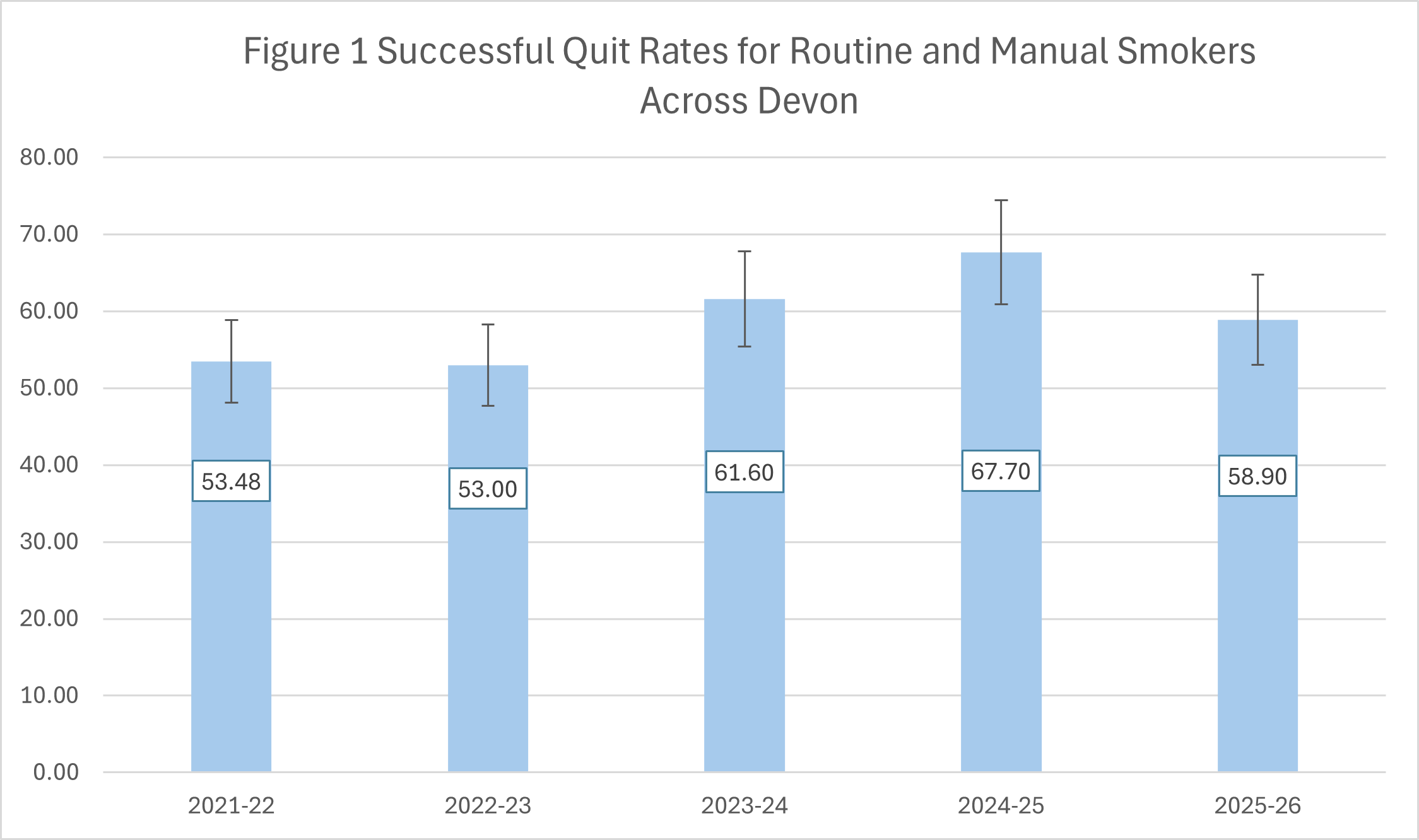
Source: Devon County Council Locally Commissioned Stop Smoking Service Data
Unmet Need
In Devon, nearly 1 in 4 Routine and Manual workers smoke (23.5%), significantly higher compared with the national average of 19.2%. This group is almost four times more likely to be current smokers than those in other occupations, yet uptake of stop smoking services remains limited. While quit success rates among those who do engage are encouraging, rising to 67.7% in 2024–25 before dipping slightly, the overall reach of services (24.2%, n=668) does not match the level of need. This gap highlights a critical opportunity to improve targeted engagement and reduce smoking-related health inequalities.
Qualitative Insights
Much of the available qualitative research into smoking behaviours and service engagement among Routine and Manual workers in Devon is from earlier engagement reports, some dating back over a decade. While these findings remain valuable, they may not fully reflect current attitudes, service models, or the impact of recent public health campaigns and digital developments.
- Awareness vs. Uptake: While over 75% of respondents had heard of the NHS Stop Smoking Service, fewer than one-third had used it.
- Self-Directed Quitting: Many preferred to quit alone using e-cigarettes or nicotine patches, indicating a desire for autonomy and possibly a lack of trust or understanding of formal services.
- Timing and Location: Shift work and irregular hours made it difficult to attend scheduled appointments. Face-to-face support was preferred, especially in familiar settings like GP surgeries or pharmacies.
- Mental Health Needs: Individuals with mental health conditions expressed a strong preference for one-to-one support and valued peer support after quitting.
- Perceived Relevance: Some participants felt the service wasn’t designed with their lifestyle or needs in mind, and messaging didn’t always resonate.
- Workplace Culture: Smoking is often embedded in workplace routines, especially in manual jobs, making it harder to break the habit without workplace-level interventions.
- Digital Exclusion: Limited access to online tools and resources can prevent engagement with modern cessation support, particularly among those with low digital literacy or connectivity.
- Stigma and Messaging: Participants preferred positive, relatable messaging over graphic or fear-based campaigns, which were seen as alienating
Sources: Smoke Free Alliance Progress Report (2023-24), Health Watch Smoking Cessation Engagement (2015)
Rapid Evidence Review key points
Evidence from recent studies highlights the complex factors influencing smoking and cessation among routine and manual workers.
- The Healthwatch Derbyshire report found that while many are motivated to quit, barriers such as shift work, mental health challenges, and low awareness of free support limit access.
- A qualitative study in southeast England identified stress, workplace culture, and gender norms as key drivers of relapse, despite strong motivators like health concerns and family influence.
- The NHS Kirklees case study demonstrated that tailored, community-based approaches, such as informal settings, peer support, and relatable messaging, can significantly improve service uptake and quit rates in this high-risk group.
What does this tell us?
Routine and Manual workers in Devon continue to experience disproportionately high smoking rates, despite overall progress in reducing smoking prevalence across the county. This group faces unique and persistent barriers to accessing cessation support, including workplace culture, shift patterns, mental health challenges, and digital exclusion. While quit success rates among those who engage with services are encouraging, uptake remains low, highlighting a clear gap between need and reach.
Without targeted action, these inequalities will persist, contributing to avoidable illness, premature death, and increased pressure on local health systems. There is a critical opportunity to redesign services and messaging to better reflect the lived experiences of R&M workers, improve accessibility, and ensure that support is both visible and relevant. Doing so will not only improve individual health outcomes but also contribute to wider efforts to reduce health inequalities and achieve a smoke-free Devon.
Recommendations
1. Strengthen Targeted Outreach and Messaging
- Develop tailored campaigns that reflect the lived experiences of R&M workers, using positive and relatable messaging rather than graphic or fear-based approaches.
- Engage trusted community voices and peer advocates to promote services in familiar settings such as workplaces, local venues, and social spaces.
2. Improve Accessibility of Services
- Expand service hours and locations to accommodate shift workers, including evening and weekend options.
- Offer flexible formats such as drop-in clinics, mobile outreach, and informal peer-led sessions.
3. Enhance Service Relevance and Cultural Fit
- Co-design interventions with R&M workers to ensure services feel relevant and respectful of their autonomy.
- Address workplace culture by working with employers to support smoke-free environments and promote cessation support during work hours.
4. Address Mental Health and Stress-Related Smoking
- Integrate mental health support into smoking cessation services, including one-to-one counselling and trauma-informed approaches.
- Provide training for practitioners to recognise and respond to stress-related smoking behaviours.
5. Tackle Digital Exclusion
- Ensure cessation support is available offline and in formats accessible to those with low digital literacy or limited internet access.
- Promote digital tools through trusted intermediaries and offer support to navigate online resources.
6. Update Local Insight and Engagement
- Conduct up to date qualitative research to refresh understanding of barriers and motivators among R&M workers, particularly in light of changing service models and digital developments.
- Use participatory methods to gather lived experience and inform service redesign.
7. Use Local Data to Target High-Need Areas
- Develop a composite measure which includes prevalence data, occupation, deprivation and age to identify priority communities geographically.
- Use local data and information to identify higher prevalence workplaces.
- Use mapping tools and dashboards to visualise hotspots and guide resource allocation, ensuring interventions are focused where they are most needed.
8. Monitor and Evaluate Equity of Reach
- Track service uptake and quit outcomes by occupation, education level, and deprivation to identify gaps and target resources effectively.
- Use local dashboards and data tools to support continuous improvement and contract monitoring
DML (2025)